Disclosure: I'm a Flodesk Partner, which means I earn a commission if you sign up through my link, at no extra cost to you. I only recommend tools I love or use in my own business!
If you've ever poured everything into a launch and then gone quiet on your email list afterward, I get it, because I've done it too!
Whether you use Flodesk (the email platform I recommend to nutritionists, because it's so easy to set up and use) or something else, what keeps your list warm is what you send between launches.
To keep subscribers engaged between launches, email your list once a week with one of three emails: an educational email that teaches one thing, a storytelling email that shares a client win or a real moment from your week, or a weekly roundup of what's new.
Add a P.S. to every email that tells people how to work with you, so your list stays warm and your offer never feels like it came out of nowhere.
Here's my real rhythm: During a launch, I email my list 1-2 times a day. Between launches, I aim for one email a week, usually a weekly roundup, a story from my business or an educational email.
And the mistake I still catch myself making from time to time is not prioritizing those weekly emails when there's no launch on the calendar.
I pulled my own email stats while writing this post, and after my last launch wrapped up, my list didn't hear from me again for a whole month. So consider this post me holding myself accountable too!
In this blog post, I’ll walk you through the three types of emails I send between launches, the simple structure behind every one of them, and a weekly plan you can copy. Plus, how to grow your list with a Flodesk opt-in page so there are more people to email!
If you're just getting started and want your email list, freebie and first emails set up step by step, Launch Your Nutrition Biz walks you through it, including click-by-click Flodesk tutorials. Learn more here.
Why Do Emails Between Launches Matter So Much?
Emails between launches build the trust that makes people say yes when you launch. A list that hears from you every week is warm and ready when your doors open.
Think about it from your subscriber's side. If the only time they hear from you is when you're selling, every email starts to feel like a pitch.
But if they’ve been getting a helpful email from you every week, your launch feels like the natural next step from someone they already trust.
Your email list is also the one audience you actually own!
I've watched nutritionists lose their Instagram accounts overnight, and the ones with an email list could still reach the people who'd been following along.
You don't need a big list for this to work. Even twenty people who genuinely want to hear from you is a real list, so start where you are!

What Should I Send My Email List Between Launches?
Rotate three simple emails: an educational email, a storytelling email and a weekly roundup. One email a week is plenty.
These are the three emails I send between launches, and having them on rotation means I'm never starting from a blank screen.
1. The Educational Email
Teach one thing your ideal client wants to know. That could be a myth she believes, a quick win she can try this week, or a lesson from something that happened in your week.
One idea per email keeps it easy to write and easy to read.
For example, a nutritionist who helps women with PCOS/PMOS might send "Why your 3 pm energy crash isn't about willpower," with one simple tip for a steadier afternoon snack.
Got a podcast, blog or YouTube channel? Your educational email can teach one idea from your newest episode or post and link to the rest.
That's what I do every time a new podcast episode comes out.
For my email "5 ways to make posting easier" I asked how much time my readers had spent on social media content that week, shared three of my podcast episode's tips as bullet points, and linked to the full episode.
2. The Storytelling Email
A storytelling email shares a real moment and connects it to a lesson your reader needs.
Stories are what make people feel like they actually know you, and that's a big part of why they buy from you.
There are four kinds of stories you can rotate through:
A client win. Like how one client finally slept through the night after six weeks of small changes (shared with her permission).
A personal win. Something you're proud of in your business or your own health, like finally sticking to a morning routine.
A client story. A struggle a client was stuck on and what helped her move forward, even before the big result.
A personal story. A real moment from your week, like forgetting your lunch and crashing at 3 pm.
This is the email type my own list loves most!
When I looked at my stats, my three most-opened emails since May were the ones where I got personal or simply asked how I could help.
"My content got boring (& here's what I'm doing about it)" had a 49.71% open rate, "Have a business question? Let me help!" had 49.03%, and "I took 3 weeks off my business and here's what happened" had 47.04%.
My average open rate over the last 90 days is about 38%, so if you've been wondering whether to share the real stuff, this is your sign!
Use the Story, Pivot, Point, CTA structure below, and keep the story shorter than the lesson. And always ask a client's permission before sharing their win, or leave out anything that could identify them.
3. The Weekly Roundup
My weekly roundup is called "Weekly What's New," and it follows the same simple layout every time:
A short personal intro that leads into this week's podcast episode
What's New on the Podcast (the episode link)
YouTube Video to Watch (one video link)
An invitation (whatever I'm promoting, like a free workshop)
My sign-off, plus one last reminder about the invitation
One of my recent Weekly What’s New emails went to 2,709 people and had a 43.15% open rate, well above my average (people really do love a behind-the-scenes peek!).
For a nutritionist, a roundup could be a quick update from your week, your newest recipe or blog post, one health tip, and one line about how to book a call.
Because the layout stays the same, it's so much faster to write each week.
Want to see these emails in action? Grab my free workshop and you'll start getting my weekly emails too!
One quick note: keep the advice in all of these emails general.
Individual recommendations belong inside your sessions, where you know the person's full health picture.

How Do I Structure an Email So People Actually Read It?
Use a simple four-part structure: a short story, a pivot to your reader's situation, one clear point and one call to action. It keeps every email short and personal.
This is the exact structure I use for my own emails, and it's a game changer when you're staring at a blank screen:
Story. A short, real moment from your week (two or three sentences, not a novel).
Pivot. One line that connects your moment to your reader's situation.
Point. The one lesson, tip or reframe you want her to walk away with.
CTA. One clear next step: reply, read, listen, book or join.
Here's how that might look for a PCOS/PMOS nutritionist's educational email:
Story: "I forgot my lunch on Tuesday and ended up grabbing a muffin at 3 pm. By 4 pm I was exhausted and cranky."
Pivot: "If your energy crashes every afternoon, it might not be about willpower at all."
Point: One simple tip about building a steadier afternoon snack.
CTA: "Hit reply and tell me what your go-to snack is right now."
Here's a real one. My email "My content got boring (& here's what I'm doing about it)" followed this exact structure:
Story: I'd posted a bloopers reel on Instagram, laughed so hard making it, and realized I hadn't felt that way making content in a really long time.
Pivot: So many of my business friends and clients had been telling me how heavy content creation felt right now.
Point: People don't follow you for the perfect tips. They follow you because they like you, so make content you actually enjoy making.
CTA: Watch the bloopers reel, with a P.S. linking to my newest podcast episode.
And here's how my three between-launch email types performed with my own list:
| Type | Sent to | Open rate | Click rate | |
|---|---|---|---|---|
| My content got boring (& here's what I'm doing about it) | Storytelling | 2,887 | 49.71% | 1.73% |
| Peek at my weekly routine | Weekly What's New | Weekly roundup | 2,709 | 43.15% | 1.44% |
| 5 ways to make posting easier (new episode) | Educational (podcast episode) | 2,707 | 35.98% | 0.81% |
| My average, last 90 days | All emails | 37.99% | 1.12% |
Want a fill-in-the-blank version? Copy this:
Subject: [The question or myth your email answers]
Hi [first name],
[2 to 3 sentences about a real moment from your week.]
[1 sentence connecting that moment to her situation.]
[Your one point, in 3 to 5 short sentences or a few bullets.]
[One call to action.]
[Your sign-off]
P.S. [A gentle reminder of how to work with you.]
How Often Should a Nutritionist Email Their List?
Once a week between launches is ideal, and every two weeks is fine when you're starting. During a launch, you can email much more often.
Between launches, I aim for one email a week. During a launch, I email 1-2 times a day, because that's when people are actively deciding and need the details.
But if you're brand new, please don't start with twice a day! A steady weekly email is so much more valuable than a burst of emails followed by months of silence.
Here's what makes the weekly rhythm easier:
Pick a send day and treat it like a client appointment (I always send my emails on Wednesday’s)
Batch two to four emails in one sitting and schedule them ahead in Flodesk
Keep a running list of ideas in your phone (every client question is an email waiting to happen)
You can always email more often later. Start with what feels doable right now!
What Does a Simple Between-Launch Email Plan Look Like?
Rotate your three email types over four weeks and mention your offer in a P.S. every single time.
Here's a plan you can copy:
| Week | Email type | Example subject line | CTA |
|---|---|---|---|
| 1 | Educational | Why your 3 pm energy crash isn't about willpower | Hit reply with your biggest question |
| 2 | Storytelling | How one client finally stopped skipping breakfast | Hit reply and share your own win |
| 3 | Weekly roundup | What I'm cooking, reading and loving this week | Book a call to work together |
| 4 | Educational + invitation | The one habit I start with every new client | Book a call to work together |
Then repeat! And keep that P.S. in every email, so the people who are ready to work with you never have to go looking for how.
If you already have clients but your income goes quiet between launches, this is exactly the kind of rhythm we build inside my program Booked Out Nutritionist.
How Do I Grow My Email List With Flodesk?
Create one free resource your ideal client wants, put it on a Flodesk opt-in page, and share that one link everywhere you show up, every week.
Here's how we set it up, step by step:
Pick one freebie tied to your niche. A grocery swap guide, a recipe bundle, a 3-day meal plan or a short video training all work. One great freebie beats five okay ones. (Mine are a free workshop for new nutritionists and the Nail Your Nutrition Niche Workbook.)
Build your opt-in page in Flodesk. Start from one of Flodesk's templates, add your photo, a clear headline that names the result, and three bullets on what's inside.
Connect a welcome sequence. Set up a Flodesk workflow that delivers the freebie, then sends two follow-up emails introducing who you are and how you help.
Share it everywhere. Your Instagram bio, a ManyChat keyword that sends the link in a DM, the end of every blog post, your podcast or YouTube descriptions, your email signature and a pop-up on your website.
Check your numbers once a month. Look at how many people visit your opt-in page and how many sign up. If lots of people visit but few sign up, test a clearer headline first.
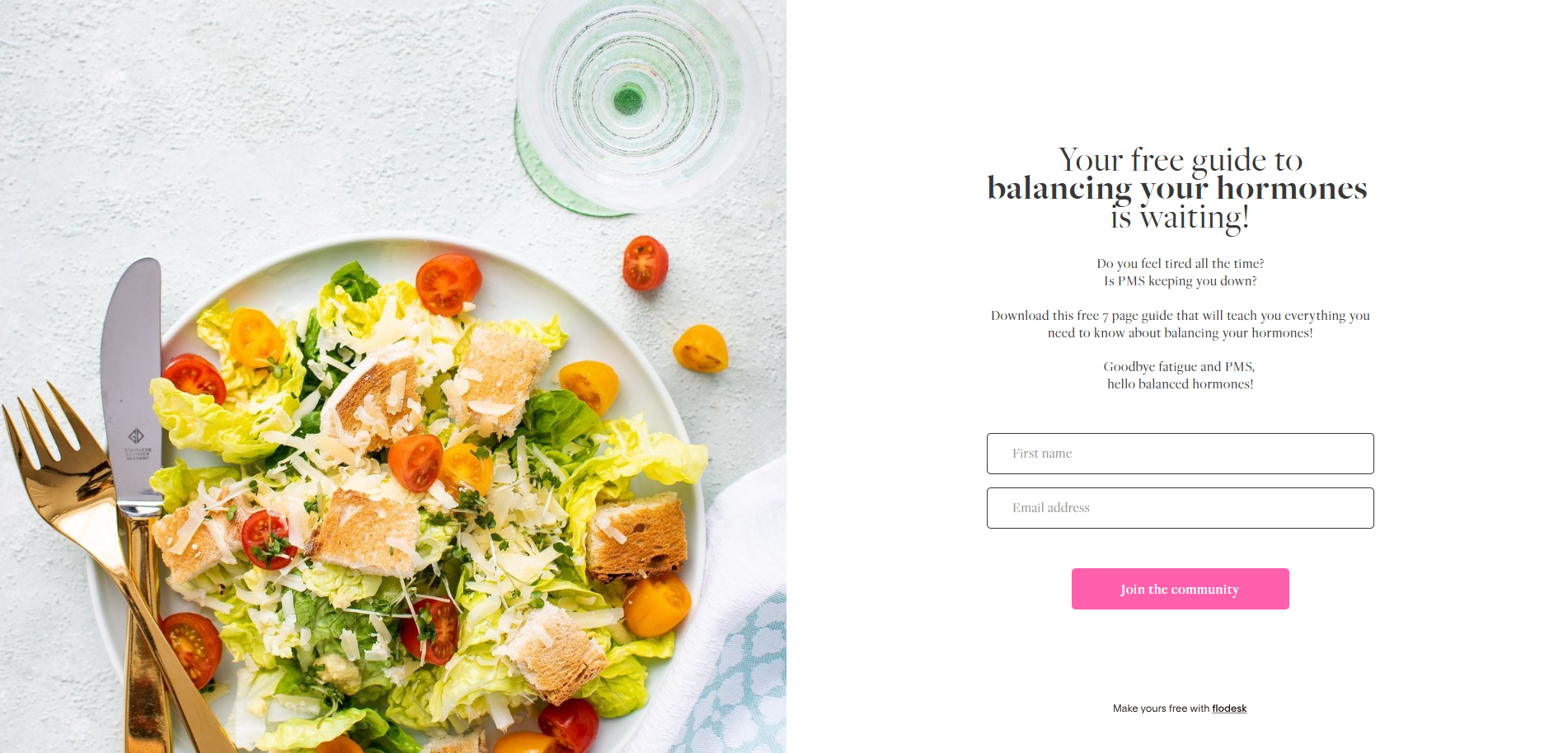
Here's a sample Flodesk opt-in page I built so you can see how simple it can be.
And here's one more thing I do: every so often, I clean out cold subscribers, the people who haven't opened my emails in a long time.
I did a cleanup this fall, and a smaller list of people who actually want to hear from you is worth so much more than a big list that never opens.
If you're brand new to this, my blog post on how to grow your nutritionist email list has more ideas for where to share your freebie.
Why Do I Recommend Flodesk to Nutritionists?
Flodesk makes it easy to create emails and opt-in pages that look beautiful, even if you’ve never designed anything before.
That means you can spend your time on what you send, instead of fighting with the tech.
When I recommend an email platform to nutritionists who are just starting out, I look for three things: it has to be easy to use, it has to look professional right away, and the numbers have to be easy to understand. Flodesk checks all three!
Here’s how it fits into the between-launch plan we just walked through:
Your weekly emails: start from one of Flodesk’s templates, then duplicate last week’s email each time, so your weekly roundup takes minutes instead of hours.
Your opt-in page: build your freebie page in Flodesk (like the sample I shared above) and share that one link everywhere.
Your welcome sequence: set up a workflow once, and every new subscriber automatically gets your freebie plus two follow-up emails.
Your numbers: check your open rates and sign-ups once a month, so you know which emails your list loves most.
What Are Flodesk's Unlimited Plans?
Flodesk has two plans, Unlimited Email and Unlimited Everything. Both include unlimited subscribers and unlimited emails for one flat price. Unlimited Email starts at $38 a month and Unlimited Everything starts at $79 a month, billed annually.
Your price stays the same whether you have 500 subscribers or 50,000, which is what makes Flodesk so affordable in the long run!
So you can email your list every week between launches (and twice a day during a launch!) and share your freebie as widely as you like. Get 25% off your first year on Flodesk here.

Email List FAQs for Nutritionists
What should I send my email list between launches?
Send one helpful email a week: an educational email, a storytelling email (a client win or a real moment from your week), or a weekly roundup. Always mention how to work with you in the P.S.
How often should I email during a launch?
You can email much more often during a launch, because people are actively deciding. I email my list 1-2 times a day during a launch, then go back to once a week between launches.
What should my first email to my list be?
Your first email should deliver your freebie, say who you help and what you help with, and tell subscribers how often they'll hear from you. Keep it warm and short.
What if I only have a few subscribers?
Email them anyway! A small list is the perfect place to practice your writing, and the habit you build now is what grows your list later.
Can I share health advice in my newsletter?
You can share general, educational information. Individual recommendations belong in your sessions, where you know each client's full health history.
Keep Showing Up, One Email a Week
Your list doesn't need to be big, and your emails don't need to be perfect. One helpful email a week between launches keeps your list warm, so when you do open the doors, the right people are ready to say yes.
Take it one email at a time, starting with this week's. You've got this!
Looking for a step-by-step online course to help you set up your email list and start your nutrition business without the overwhelm?
Launch Your Nutrition Biz is my step-by-step online course for newly certified nutritionists. Inside, you'll get:
13 modules that take you from "I'm certified, now what?" to signing your first paying clients
Email list and freebie setup, step by step
Click-by-click tech tutorials, including Flodesk, Practice Better, Canva and Squarespace
Done-for-you templates, including welcome emails and email sequences
A 30-day launch plan
Lifetime access
About the Author: Stephanie Long is a Nutrition Business Coach and the creator of Launch Your Nutrition Biz and Booked Out Nutritionist, programs that have helped hundreds of Nutritionists start and grow their practices since 2017. She is the host of the Booked Out Nutritionist Podcast, with 170,000+ downloads, and specializes in helping nutritionists start their business and sign their first paying clients. Learn more at stephanielong.ca.
Love this blog post? Save it on Pinterest!